Obstacle Detection System
Electrical/Computer Science · August 2026
Overview
For my internship, developed a handheld LiDAR-based terrain detection system using an ESP32, laser rangefinder, and inertial sensor. Designed algorithms to compensate for hand tilt, filter noisy measurements, and reliably classify step-ups and step-downs. Built a working prototype with buzzer/LED alerts and Bluetooth communication to a live browser dashboard.
Gallery · 01 items
Project gallery
01
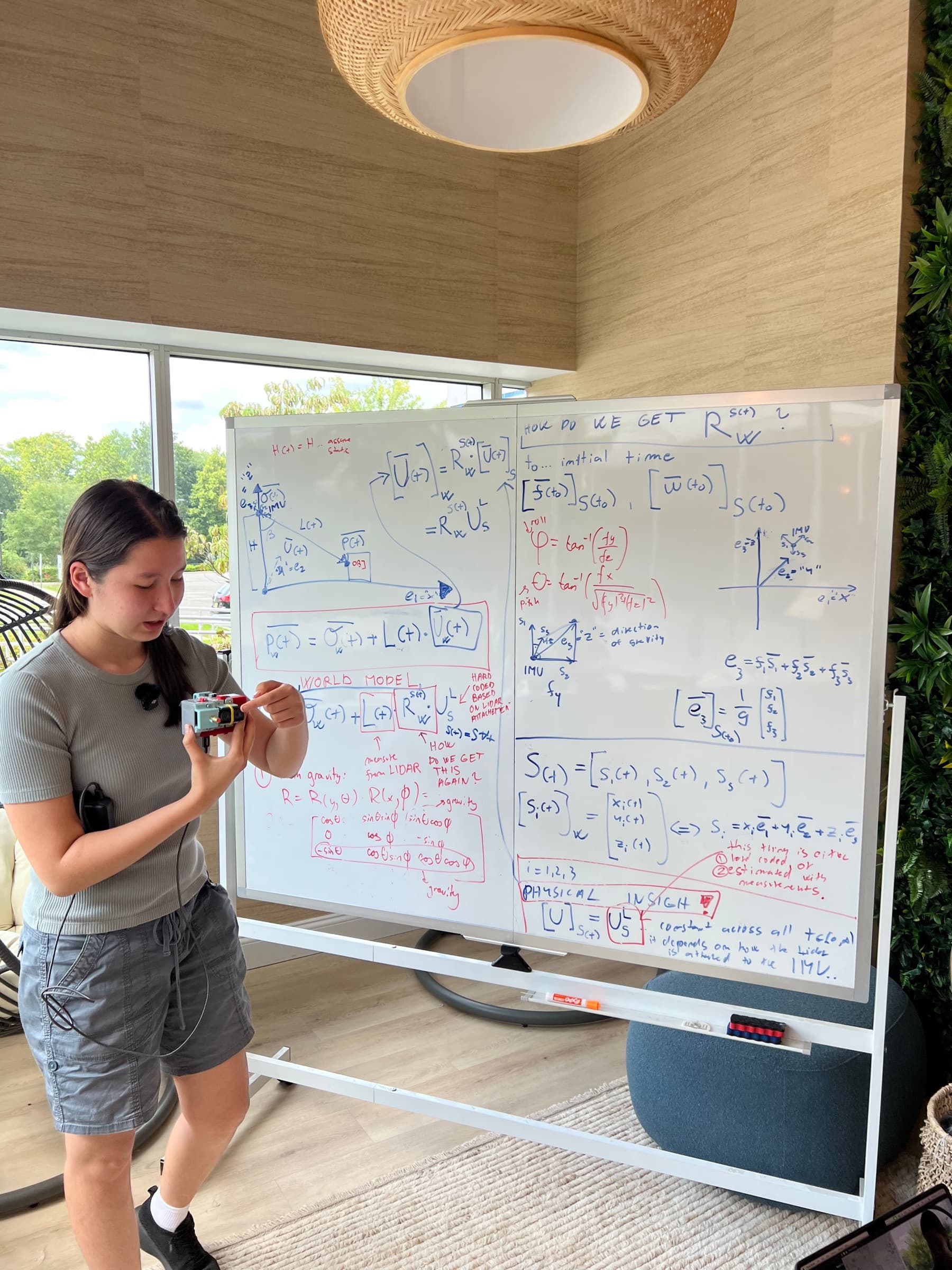
Working through the mathematical model
Returning for a second term allowed me to immediately dive into the development pipeline, where I worked on a handheld LiDAR-based terrain detection system designed to detect changes in ground level and provide a warning to the user. A key challenge was that the distance measured by the laser changes not only when the terrain changes, but also when the person holding the sensor tilts their hand. I integrated a laser rangefinder, an inertial sensor, and an ESP32 microcontroller to interpret these measurements relative to the ground. Working closely with my supervisor, I developed the mathematical model and translated it into a working prototype. My firmware combined gyroscope measurements with accelerometer-based tilt correction to estimate the laser’s direction and calculate terrain height. I also implemented calibration procedures, rejected measurements taken at shallow viewing angles, and required repeated, consistent readings before classifying a change as a step. This allowed me to carry the mathematical model through to the practical challenges of noisy real-world sensor data. In less than three weeks, I progressed through multiple iterations to a prototype capable of classifying both step-ups and step-downs, triggering buzzer and LED alerts, and transmitting data via Bluetooth to a live browser dashboard. I also contributed mechanical assembly designs and developed diagnostic tools that made the system easier to test, understand, and continue developing. I applied my robotics experience to implement sensor filtering, PI control loops, Bluetooth connectivity, and real-time data processing, demonstrating my ability to move from mathematical concepts to functioning physical systems.